


Thoughts:
Unspoken expectations are like termites in the roof. You only see the damage when it falls on your head.
The investor shows up once. The operator shows up every day. Put a price on that difference on day one.
Every partnership is a list of promises. Write them down before they grow in the dark.
Someone sent me this question:
“What is your take on partnership? Someone wants to bring capital, then pay someone for ads, while I handle the other stuff like running the ecommerce business while we share the profit.”
Good question. Scary question too.
I have done many partnerships.
Some are still running after two years.
One ended with my partner firing EVERY single staff and shutting the whole business down.
Overnight.
I kept asking him, “Bro… what happened… what’s going on… what do you mean by you quit?” Long story…
So let me give you the answer I paid for.
This is for Ecommerce but it can work for any business.
Most people treat a partnership like two friends doing business. “We move!”
For the first three months, it’s sweet. Orders are coming. You are sending each other screenshots at 11pm.
Then the business grows. The work grows.
One person starts to feel like he’s carrying the other on his back. That feeling kills partnerships.
Someone expected something. The other person never knew.
Every partnership is a list of promises. The ones you write down, you can manage.
The ones you only said with your mouth grow in the dark until they blow up in your face.
So ask a better question.
What exactly is each person promising, and what happens when someone stops?
Good news for the person who asked: your setup is the one I like most. One person brings money. One person does the work. Profit gets shared.
It works if you get everything right. So let’s start there.
Build the company before you share the profit
One document can save this partnership. Most people go looking for it after the fight starts.
Think about marriage in Nigeria.
Before any wedding, the two families sit down for the introduction. The list comes out.
Everybody knows what is expected before anybody says “I do.”
Nobody shows up after the wedding to say, “By the way, we wanted a goat, not a ram for the traditional wedding.”
Your partnership needs that list. And the list must belong to a company.
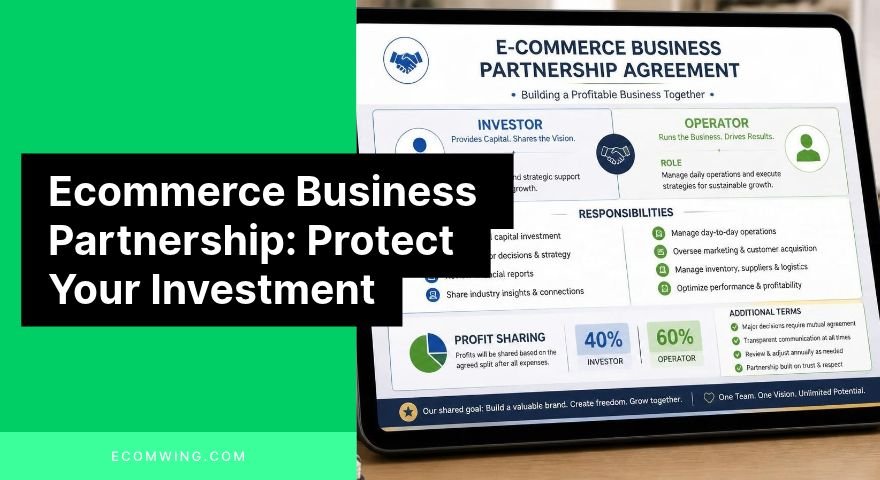
Register a limited company. Both of you own shares in it. The company owns the bank account, the ad accounts, the Facebook page, the customer list and the stock. If one person walks away, the business stays standing.
Then your agreement needs three lists. I call them the 3 Rs.
Rules. Who decides what.
Responsibilities. Who does what, and when.
Rewards. Who gets paid what, and when.
Miss one and you have a hole in the bucket. You won’t notice the leak on day one. You’ll notice it when the bucket is empty.
Every single one of these must be written down.
Signed by both of you. A copy kept by each of you.
“We discussed it” won’t save you in 9 months.
Let me show you what goes inside each one.
R1: The rules (who is in charge of what)
Think of a football match.
Twenty-two players. One ball. Everybody wants to win. But the match still works, because everybody knows the rules BEFORE kickoff.
Nobody argues about offside in the 89th minute and says, “Ah, I didn’t know.”
Partnerships fight about decisions more than money. (Read that slowly, AGAIN)
Things like “Why did you increase the ad budget without telling me?” “Who told you to sack the sales girl?” “Why are we selling a second product?”
Each of those fights is a rule nobody wrote.
So split your decisions into levels.
Decisions the operator makes alone (daily running):
- Which delivery agents to use in each state
- Staff schedules and daily targets
- How to handle a customer complaint or a refund under an agreed amount (say ₦30,000)
- Restocking the same product when stock runs low
- And other daily tasks and decisions.
Decisions both partners must agree on:
- Any single spend above an agreed amount (say ₦200,000)
- Raising the daily ad budget above an agreed cap
- Adding a new product or killing the current one
- Hiring or firing a staff member
- Bringing in a new partner or new money
- Taking a loan in the company’s name
- Anything that can stop the business now or affect the business in the long term.
Money rules:
- Every naira in and out passes through the company account. No “I’ll collect this one in my personal account and send it later.”
- Transfers above the agreed amount need both signatories or approval
- Nobody pays personal bills from the company account. Not even “small small.”
- Both partners can see the bank statement any time, without asking permission
Asset rules:
- The ad accounts, page, website, phone and customer list belong to the company
- Both partners have admin access to everything. The media buyer gets the access he needs to do his job, never full ownership
- Nobody uses the customer list to sell their own side product
The tie-breaker rule:
At 50/50, a disagreement can freeze the business. Agree NOW on who breaks a tie.
It could be a mentor you both trust, or you could give one partner the final word on specific areas (operator decides operations, investor decides on new spending).
Write it down while you are still friends.
Rules feel stiff at the start. “Ah, we trust each other now.” Good. Rules are how you keep trusting each other in month nine.
But a rule only tells you who decides. It doesn’t tell you who shows up at 9am…
R2: The responsibilities (who does what, and when)
Here is a test.
Ask each partner to write down what the other person is supposed to do every week.
Do it separately. Then compare.
I promise you, the two lists won’t match.
That gap is where every “but I thought you said…” comes from.
So write the responsibilities down for every role.
“Handle customer service” is a wish. “Call every new order within 2 hours, between 8am and 8pm” is a responsibility.
Here is what a list could look like for your setup.
The operator (you).
Every day, all new orders are called and confirmed by 10am.
Confirmed orders go to the delivery agents throughout the day.
By 6pm, delivery results are updated and failed orders are followed up.
By 9pm, the day’s numbers are in the shared system (sheet/crm): orders, confirmed, delivered and cash received.
Every week, you count stock, reconcile payments with the delivery agents and review staff targets.
You also prepare the numbers for the partner meeting.
By the 3rd of every month, you close the books: sales, costs, profit and cash in the account.
And all the time, you write and update the SOPs and sales scripts, and you train and manage the staff.
The investor (the capital partner).
He releases capital on the dates he promised.
For example, ₦1,500,000 at the start and another ₦1,500,000 after the product proves it can sell.
He attends the partner meeting every week and reviews the numbers.
When a decision needs both partners, he responds within 48 hours.
And he brings anything else he promised, like supplier contacts, a warehouse or introductions or maybe just the money (this is a redline, I’ll explain later)
That last part matters. If he said he’ll “help with connections,” write down WHICH connections and by WHEN. Vague promises become loud fights.
The media buyer (hired, not a partner).
He checks the ads twice a day at set times, pauses the losers and reports any big change.
By 9pm every day, he puts the day’s spend, cost per order and orders in the shared sheet.
Every week, he tests the agreed number of new ad creatives and sends a short report on what worked, what didn’t and what he’ll test next.
Then add one more line under every role: what happens when it’s not done.
Miss once? We talk about it at the weekly meeting.
Miss the same thing three weeks in a row? We sit down and review the role, the pay or both.
The point is to remove the guessing.
When the list is clear, nobody has to read minds.
And in my experience, nobody in Nigeria is a good mind reader. We are too busy.
Now everybody knows their job. Which brings us to the question everybody REALLY cares about…
R3: The rewards (who gets what, and when)
Money talk is awkward. So people skip it.
They say, “We’ll share the profit.” Share how? When? After what? From which month? Nobody knows.
So everybody assumes the answer that favours them.
Think about ajo (esusu). It works for years in markets all over the country. Why?
Everybody knows how much they put in, which week they collect and how much they collect. The day someone collects out of turn, the ajo scatters.
Your rewards need that clarity at every stage of the business. Write down what each person gets at each point in time.
Stage 1: Testing (no profit yet)
The business is spending capital to find out if the product sells. There is no profit to share.
Write down:
- Does the operator get a small salary from the capital during this stage, or does he work for free until there’s profit? (If free, say for how many months.)
- How much capital can be spent testing before you both sit down and decide to continue or stop?
Stage 2: Profit, while the investor’s money is coming back
Now the business is making money. First, agree on the order of payments. Here is one way to do it.
- Product, delivery, ads and staff are paid first
- The operator’s salary comes out next
- A reserve stays in the business for stock and ads (say 20%)
- What’s left is split. Part goes to paying back the investor’s capital, part is shared as profit
Let me show you with numbers. Say the investor brought ₦3,000,000.
- Business clears ₦1,500,000 after product, delivery, ads and staff
- Operator salary: ₦250,000. Left: ₦1,250,000
- 20% reserve stays in the business: ₦250,000. Left: ₦1,000,000
- Half goes to repaying the investor’s capital: ₦500,000
- Half is shared 50/50: ₦250,000 each
That month, the investor collects ₦750,000 (₦500,000 capital back plus ₦250,000 profit). The operator collects ₦500,000 (₦250,000 salary plus ₦250,000 profit).
At that pace, his ₦3,000,000 is back in his pocket in six months.
Stage 3: Capital fully paid back
Now there’s nothing left to repay. The full ₦1,000,000 is split 50/50. ₦500,000 each.
The operator still gets his ₦250,000 salary on top, so he collects ₦750,000.
These are example numbers. Your percentages can be different. What matters is that the stages are clear and BOTH of you signed them.
Other reward rules to write down:
- Payout day. Profit is shared once a month on a fixed date (say the 5th), after the books are closed. Nobody “borrows” from the company account in between.
- Bad months. If the business makes a loss, nobody collects profit that month. Losses come out of the reserve first.
- Media buyer pay. A fixed fee plus a bonus per DELIVERED order. In COD, an order that isn’t delivered is just noise. Pay for cash in the bank.
- Pay reviews. The operator’s salary is reviewed every six months, or when the business crosses an agreed monthly profit.
- Exit. If one person wants out, the other gets the first chance to buy his shares. Agree on how the price is calculated now (for example, based on the last six months’ average profit). Don’t wait until someone is angry to start negotiating.
Rewards that are written down feel fair.
Rewards that are “we’ll see” feel like theft… to somebody. Usually the person doing the most work.
And that person, in your setup, is YOU…
The 80% problem (and why your seat is the best seat)
On our Ecommerce Success Standup Coaching call, a member told me he and his partner split everything 50/50. He runs ads. His partner does operations.
I told him, “I’m not a prophet. But I’d bet 7 out of 10 times, this ends with your partner saying ‘I’m done.'”
Here is why.
When a business scales, operations does about 80% of the work. Delivery agents. Stock. Staff. Angry customers.
Meanwhile, the ads guy checks the dashboard at 2am and 2pm and goes back to sleep.
You chose operations. That is the BEST seat.
Think of a danfo in Lagos. The owner buys the bus. The conductor collects his daily pay.
But the driver knows the route, the passengers and the mechanic.
If the owner disappears, the driver can still move the bus.
Own the SOPs, the sales scripts, the staff and the delivery partners, and you hold the backbone of the business.
It’s also the most dangerous seat. The investor brings money once. You show up every single day.
In month one, that feels fine. In month eight, you will start counting the cost and the profit you could be making if you were doing this for yourself.
That’s why the operator salary sits inside the rewards list.
You are pricing your work NOW, while everybody is happy. Nobody fights over it later, because it was agreed on day one.
And the ads person? He’s the conductor. He gets paid, he holds no shares, and the ad accounts stay in the company’s name.
Don’t forget this part. Learn enough about ads to read the numbers yourself. Cost per order. Delivery rate. Cash left.
If you can’t read the dashboard, a hired media buyer can burn ₦3M of your partner’s money and still send you a fine screenshot.
You have the paper and the right seats. One boring habit still decides if you’ll be partners in two years…
The weekly meeting that saves partnerships
My partnerships that lasted two years share one secret. It’s so simple you might laugh.
Most partnerships end in silence. You stop calling. He stops replying. Nobody watches the ads. Nobody closes orders.
The cure is a weekly meeting with one question: “What expectation is not being met right now?”
Run the meeting like this:
- Same day, same time, every week
- Numbers first: orders, delivery rate, ad spend, profit, cash left
- Go through the responsibilities list. Done or not done?
- Each person answers, “What did you expect from me this week that I didn’t do?”
- Write down any change in rules, roles or rewards, and update the agreement
That’s why the 3 Rs are written down. The meeting is where you check them. Without the list, the meeting turns into feelings. With the list, it’s just ticking boxes.
An investor who sees the numbers every week stays calm. One who sees nothing starts to imagine things.
Will it be awkward? Yes.
Better to hear it on a Monday call than find out when your partner shuts the business down. And if your partner skips three meetings in a row, that’s your early warning.
One last warning. Don’t download an agreement template from Google.
Take your 3 Rs to a lawyer and let him turn them into a proper agreement. The fee pains you once. A fight over a ₦100M business pains you for years.
You can do this. Most partnerships fail on things nobody wrote down, and now you know exactly what to write.
The SOPs, scripts, staff and numbers behind that operations seat are what we build with our members every week.
Want help setting up business with partners or growing your ecommerce business? Book a call: https://ecomwing.com/call
If you need more help, you can also join our programs.


